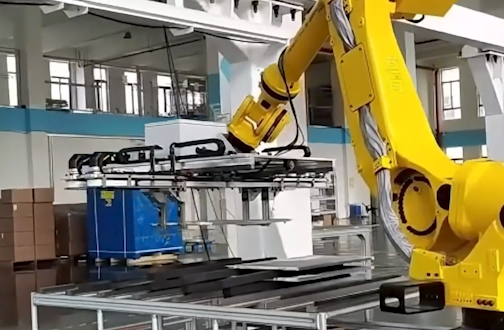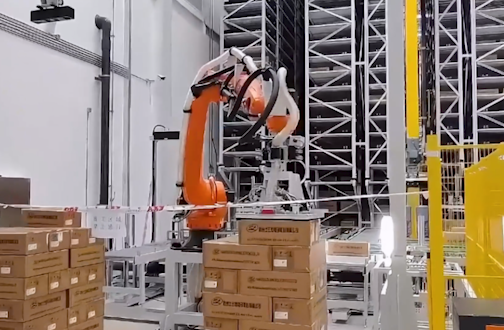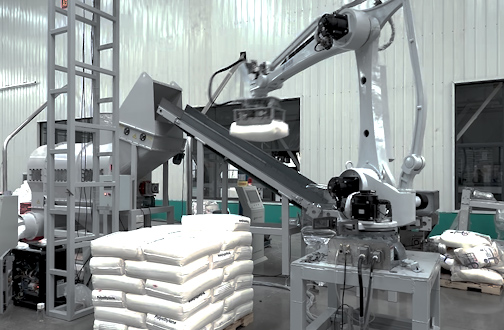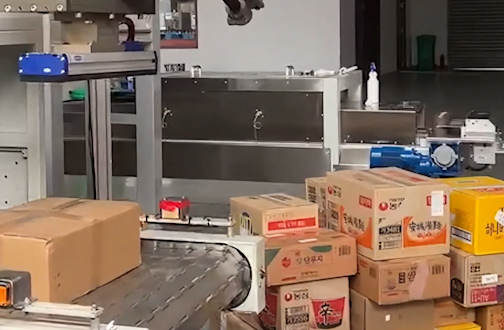






In heavy machinery and energy equipment manufacturing, handling and loading large steel components has long been a core challenge in automation upgrades. When dealing with accumulators that are heavy, have diverse specifications, and are often stacked in a semi-random fashion, traditional mechanical positioning solutions often fall short.
Recently, Transfer Technology provided a vision-guided solution centered around the Epic Eye Laser L V2S 3D industrial camera for a leading smart equipment integrator. This solution successfully enabled high-precision, high-efficiency automation for moving accumulators from material trays to processing stations.
Project Background
As a typical heavy steel component, the accumulator faces challenges in production due to its varied specifications and the fact that it is stacked within a 1.25-meter deep material tray. Given the large span of the components, their weight, and the randomness of their placement, traditional manual solutions are difficult to apply. The key to improving overall line efficiency is ensuring that robots can “see clearly” and “pick precisely” these heavy components.
Solution
For this project, Transfer Technology deployed a 3D vision-guided system, consisting of the Epic Eye Laser L V2S 3D industrial camera paired with a four-axis gantry robot. The core advantages of the solution lie in three main technical highlights:
High-Precision Imaging Technology:
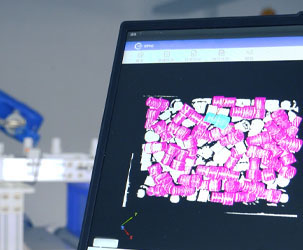
The Epic Eye Laser L V2S is specifically designed for large-field industrial applications. Even when facing dark steel surfaces, its laser imaging technology captures detailed and complete 3D point clouds, providing a solid data foundation for subsequent algorithm processing.
Powerful Adaptation Algorithms:
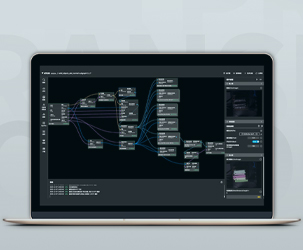
The system is equipped with an in-built database that recognizes over 11 different component specifications, enabling automatic adaptation to variations in material tray alignment.
Stable Environmental Adaptability:
With an IP65 protection rating and a specialized anti-interference algorithm, the system effectively mitigates the impact of environmental lighting changes, ensuring full point cloud data output.
Workflow
The efficiency of this system is reflected in the seamless collaboration between its hardware and software:
Triggering the Instruction:
When the PLC sends the capture command, the 3D camera responds immediately.
Point Cloud Calculation:
The system quickly calculates and outputs the optimal component pose and coordinates, with the entire vision cycle controlled within 4 seconds.
Precision Picking:
The gantry robot receives the coordinate data and, using a dedicated magnetic gripper, precisely “locks onto” the target and smoothly places it onto the unloading rack.
Performance in Practice
In real-world operation, this 3D vision system demonstrated outstanding industrial-grade stability:
Recognition Accuracy ≤ ±0.7mm:
Ensuring the quality of subsequent assembly processes.
Cycle Time ≤ 4 Seconds:
Significantly improving efficiency and reducing production wait times.
Recognition Rate ≥ 99.9%:
Eliminating downtime caused by missed recognition and manual interventions.
This project validated the technical reliability of high-precision 3D vision in complex industrial environments. The solution can be flexibly applied to other heavy-duty, multi-specification handling and loading scenarios. By replacing manual judgment with vision guidance, it achieves "high precision + high efficiency + low adaptation cost," providing a replicable solution for automation transformation in manufacturing.
 Return to List