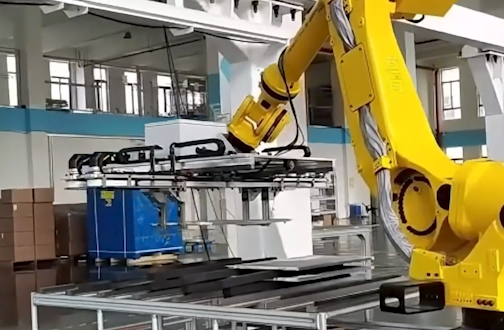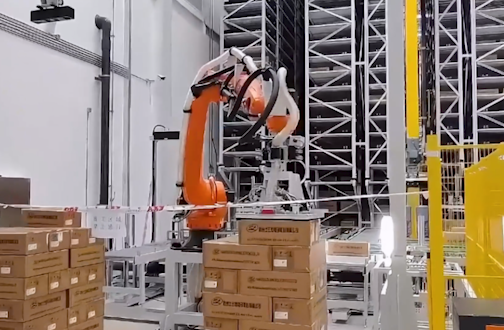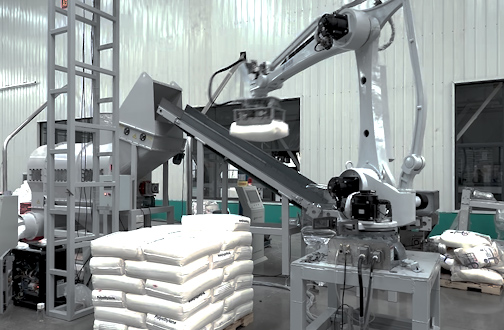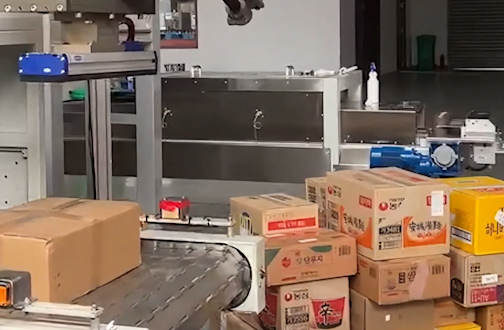




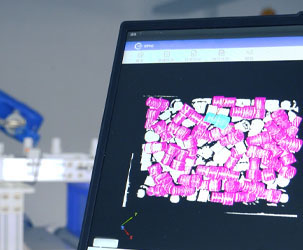


In the process of automation upgrades in the metal casting industry, workpiece positioning accuracy and operational efficiency are key challenges. Today, we share a visual-guided depalletizing project, powered by our high-precision 3D industrial camera, and how it achieves stable and efficient casting picking in real production scenarios.
01 Project Background
This project focuses on the automatic feeding of castings, where aluminum castings, stacked in material bins, need to be picked up by robots in an orderly manner and placed into designated positions. Key challenges include:
(1) The workpieces are aluminum semi-finished products, which may have surface wear and varying reflective properties.
(2) Material boxes allow some degree of offset; although the castings are stacked neatly, precise visual positioning is required.
(3) High production line cycle times demand that the recognition and calculation time per cycle be controlled within 6 seconds.
02 Core Technology
To address these challenges, the project uses Transfer Technology’s self-developed Epic Eye Laser L V2S Series 3D Camera as the "eye" of the vision system.
The camera is mounted directly above the material box, and with a single shot, it can accurately capture the 3D position and orientation of the workpieces or spacers, transmitting this data in real-time to the robot control system. Key features of the camera include:
High Precision:
The 3D vision system’s recognition precision is ≤±1mm, meeting workpiece dimensional tolerance requirements.
Accurate Recognition:
The recognition rate reaches 99.9%, ensuring continuous production.
Fast Speed:
Single shot + software calculation time ≤ 6s, matching the production line cycle time.
Interference Resistance:
The blue laser light source is unaffected by the workpiece color, adapting to aluminum surface variations.
03 Workflow
In this project, the vision system, robots, fixtures, and control systems work in close coordination to enable fully automated operations:
Intelligent Recognition:
The manual forklift transports the material box to the detection area, triggering the 3D camera to take a shot.
Precise Positioning:
The vision system identifies the center hole position and height of the workpiece, calculating the optimal picking point.
Robot Picking:
Coordinate information is sent to the robot, which uses an internal support fixture to grab the workpiece.
Spacer Handling:
Once one layer of workpieces is grabbed, the system automatically switches to a new plan, guiding the suction cup fixture to grab the spacer.
Repetitive Operation:
The process continues until the entire material box is emptied.
04 Customer Value
Cost Reduction & Efficiency:
Replacing traditional manual feeding significantly reduces labor costs and physical strain, enabling 24-hour continuous, stable operation and improving overall production line efficiency.
Ensured Production Continuity:
With a recognition rate of up to 99.9% and quick response times, the system minimizes production downtime caused by positioning failures, ensuring stable supply to subsequent processes.
Empowering Flexible Production:
The vision system offers strong adaptability, leaving room for future expansion of workpiece models, safeguarding the customer’s long-term investment.
The successful implementation of this casting automatic feeding project demonstrates the critical value of high-precision 3D vision in complex industrial scenarios. By controlling vision positioning accuracy to the millimeter level, the system not only enhances automation but also achieves the production goals of high recognition rates, high cycle times, and high stability.
As the manufacturing industry continues to advance in smart upgrades, reliable and precise visual perception capabilities are becoming the core technological support to bridge the "final mile" in automation.
 Return to List