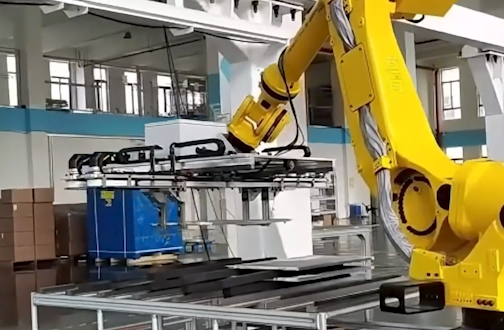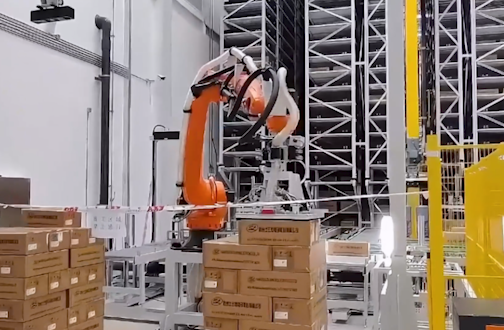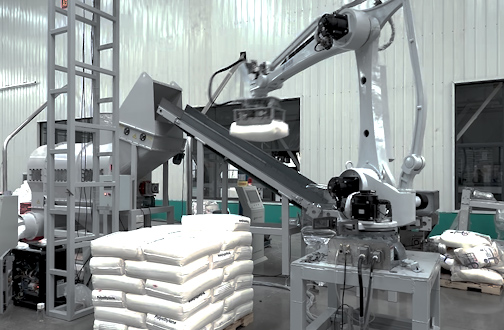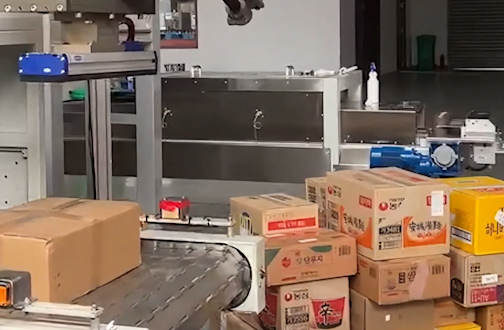






In industrial depalletizing, bagged materials have long been a significant hurdle for automation. Due to their soft texture, susceptibility to deformation, and irregular stacking patterns, traditional solutions often struggle to meet the dual demands of high precision and high efficiency.
Recently, Transfer Technology successfully deployed an intelligent depalletizing solution at a large-scale manufacturing facility. Powered by the Epic Eye Log L—a 3D camera purpose-built for depalletizing—this project provides a reliable answer to the complexities of flexible material handling, backed by solid field data and proven performance.
Core Pain Points
During the initial site survey, the client faced challenges that are highly representative of the bagged material industry:
Insufficient Positioning Accuracy:
After transportation and stacking, bags frequently sag, overlap, or stick together. Traditional 2D vision or mechanical positioning cannot precisely identify optimal pick points, leading to frequent grasping errors, offsets, or "dry cycles" (empty picks).
Demanding Operational Cycles:
Manual depalletizing is labor-intensive, and its efficiency fluctuates significantly over time, creating a bottleneck for the entire production line.
Harsh Environments & Poor Stability:
Complex lighting conditions and high dust levels in the workshop, combined with irregular stacking densities, often interfere with standard vision systems, resulting in inconsistent recognition.
The Solution
To address these complex conditions, Transfer Technology provided more than just a hardware replacement; it delivered a comprehensive intelligent depalletizing system centered around self-developed, high-precision 3D vision.
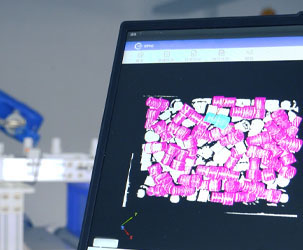
The heart of the solution is the Epic Eye Log L 3D Vision Camera. This specialized camera captures complete 3D point cloud data of stacked bags in an instant, remaining unaffected by material color, texture, or ambient light variations. The project achieved three key breakthroughs:
Millimeter-Level Recognition Precision
With a recognition accuracy of ±1mm, the camera can clearly "see" micro-gaps and deforming contours between bags. This guides the robot’s gripper to perform precise and gentle picks, fundamentally eliminating failed attempts and material damage caused by inaccurate positioning.
Ultra-Fast Visual Response Cycle
The system boasts rapid visual processing capabilities. The entire workflow—from scanning to outputting the grasping pose—takes approximately 3 seconds. This speed perfectly matches the high-frequency requirements of the production line, ensuring a seamless and efficient flow.
Robust Industrial-Grade Stability
The camera is engineered to perform reliably under complex workshop lighting and dusty environments. Once deployed, the system supports 24/7 continuous operation, completely liberating workers from repetitive, high-intensity labor.
Customer Value
Following the implementation, the 3D vision-powered depalletizing system delivered immediate and tangible ROI for the client:
Boosted Production Efficiency:
The fully automated process ensures a stable cycle time, significantly enhancing the overall throughput of the production line.
Reduced Total Costs:
By minimizing reliance on manual labor and reducing management overhead, the client also saw a decrease in material breakage caused by improper handling.
Guaranteed Production Continuity:
The success rate of depalletizing has improved dramatically, preventing missed or incorrect picks. This ensures a consistent supply of materials to the back-end production line, laying a solid foundation for the transition toward "unmanned" workshops.
Through deep expertise in 3D vision, high-performance algorithms, and a profound understanding of industrial scenarios, Transfer Technology continues to help partners overcome complex vision challenges, pushing the boundaries of intelligent and flexible manufacturing.
 Return to List