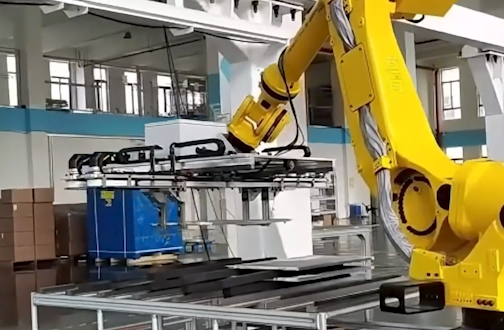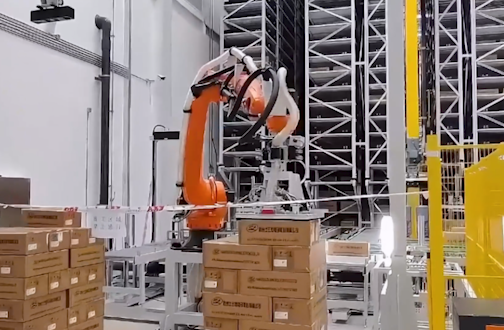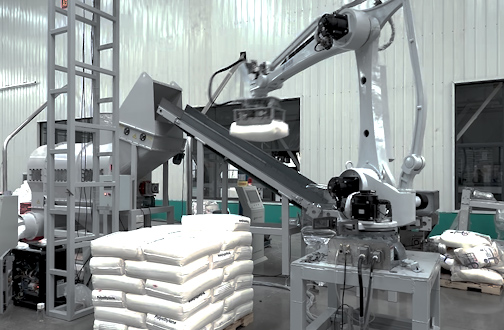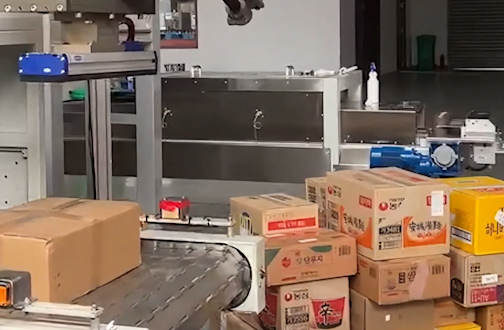






In warehouse and production logistics, box depalletizing has traditionally been labor-intensive. When handling mixed pallets with varying sizes—some even wrapped in packaging bags—conventional mechanical systems struggle to adapt, while manual operations remain constrained by efficiency and consistency limitations.
Recently, a vision-guided depalletizing system powered by Transfer Technology's Epic Eye Laser L 3D smart camera was successfully deployed at a major manufacturing facility, delivering robust performance that provides a proven solution to these challenges.
Project Challenges
The system needed to handle 7 different box sizes, with 3 types wrapped in external packaging bags—presenting multiple obstacles:
Significant size variation:
Boxes ranged from 150×150mm to 600×400mm, spanning a wide dimensional spectrum.
Complex surface characteristics:
Packaging bags are reflective, soft, and prone to wrinkling—conditions that severely impact traditional vision system stability.
Irregular pallet patterns:
Incoming pallets featured mixed SKUs with inconsistent box orientations and positions.
High throughput demands:
Continuous production required fast vision processing and seamless robot coordination.
Technical Solution
To address these challenges, Transfer Technology deployed the Epic Eye Laser L V2S 3D smart camera as the core sensing component in a complete vision-guided depalletizing solution.
The camera leverages laser triangulation technology with three critical capabilities:
High-precision point clouds:
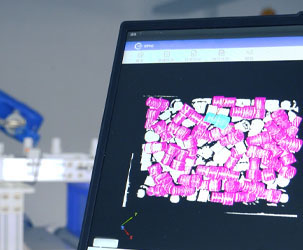
Generates detailed 3D data with clear contours, even when dealing with reflective packaging bags and color variations.
Environmental robustness:
Laser imaging minimizes ambient light interference, ensuring stable operation under complex industrial lighting conditions.
Rapid processing:
Completes capture and computation in under 4 seconds per cycle, supporting high-speed production requirements.
System Workflow
The complete system demonstrates a "sense-decide-execute" intelligent loop:
Intelligent Recognition & Localization
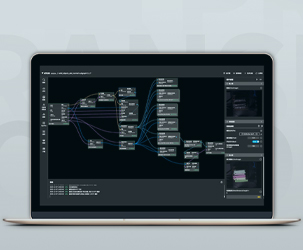
Mounted on a mobile gantry, the camera alternates between two loading stations. The vision system processes point cloud data in real-time, accurately identifying box type, XY coordinates, height, and rotation angle—whether wrapped or unwrapped—and transmits pose information to the robot.
Adaptive Gripping Strategy
Upon receiving vision data, the robot controller automatically selects the appropriate suction zones to match different carton sizes. For wrapped boxes, algorithmic compensation ensures secure gripping without slippage.
Dual-Station Operation
When Station A completes depalletizing, the camera automatically moves to Station B while prompting Station A for refill. This design enables near-continuous operation, maximizing robot utilization while minimizing manual intervention.
Delivered Results
Field deployment and testing confirmed the system meets all performance targets:
Exceptional accuracy:
Over 99.9% recognition rate across all 7 box types under standard incoming conditions.
Fast response:
Consistently completes each cycle in under 4 seconds.
Proven reliability:
Successfully passed 8-hour continuous operation testing without failures, demonstrating real-world production readiness.
As vision algorithms and hardware continue to evolve, robots will handle increasingly complex scenarios. Transfer Technology remains committed to advancing core vision technology, delivering reliable visual intelligence to the broader smart manufacturing industry.
 Return to List