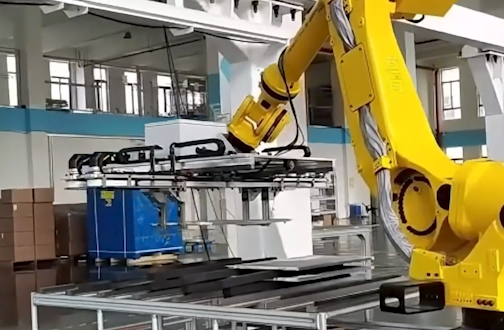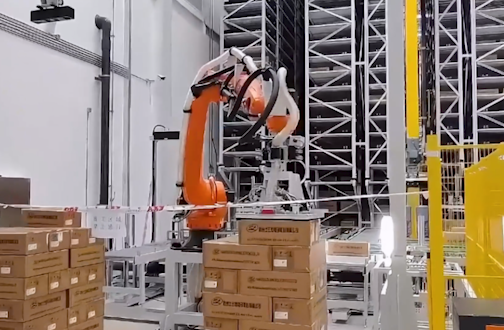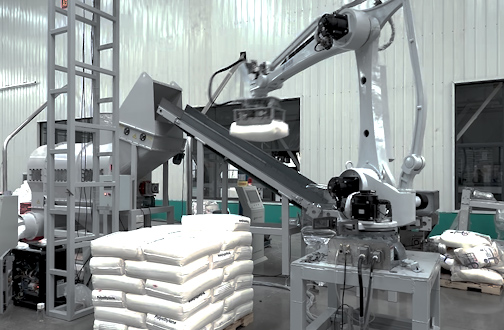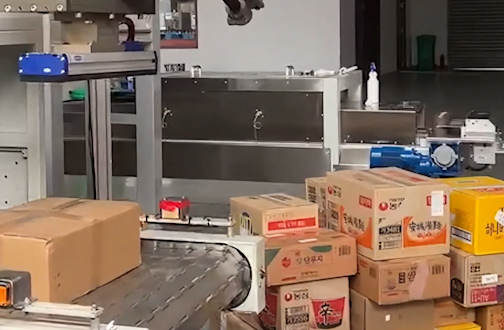






In industries such as plastics, chemicals, and food, bag depalletizing is a high-frequency operation. However, traditional manual handling comes with clear limitations: it is labor-intensive, time-consuming, offers limited daily throughput, and is prone to operator fatigue and mistakes.
Today, an intelligent depalletizing solution powered by AI and 3D vision is addressing these challenges head-on—delivering a new level of stability, accuracy, and speed. This article walks through real project data to show how the system achieves reliable and precise automated operation.
Core Challenges
In this bag depalletizing project, the material consists of M-type bags stacked in a staggered (interlaced) pattern, with a maximum stack height of up to 2.07 meters. Achieving automated depalletizing required overcoming three major challenges:
Precise Positioning:
The bags are reflective and soft, making them difficult for traditional 2D vision systems to detect consistently.
Fast Cycle Time:
Manual depalletizing is physically demanding; automated systems must match the pace of continuous production.
Strong Adaptability:
Stack deformation and slight overlaps between bags must be handled reliably.
The Solution
The project adopts a standard “3D vision–guided robot” with a clear, efficient workflow:
Loading & Triggering:
A forklift places the pallet at the fixed loading position. Once in place, the system automatically triggers the process.
3D Vision Scanning:
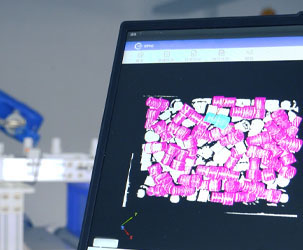
The Epic Eye Log L 3D camera, mounted on the robot arm, moves into position and scans the entire layer of bags.
Algorithm Processing:
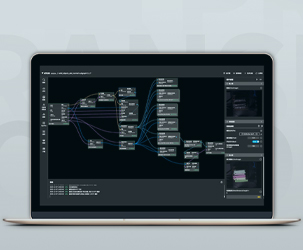
The vision system processes the point cloud in real time, identifying the precise center pose and picking point of each bag, and sends the coordinates to the robot.
Robotic Picking & Placing:
Guided by the calculated poses, the robot arm grips each bag and places it steadily onto the conveyor.
Layer-by-layer Operation:
Once a layer is completed, the robot repositions the camera for the next scan. The process repeats until the whole pallet is depalletized.
Technical Highlights
- The Epic Eye Log L intelligent camera achieves ±1 mm accuracy in both recognition and picking. This ensures every pick targets the optimal gripping zone, enabling highly stable robotic operation.
Maximum Precision: ±1 mm accuracy with zero deviation
Exceptional Efficiency: 4 seconds per layer—no idle time
- Testing shows a total recognition + calculation cycle of ≤ 4 seconds per layer, far surpassing manual efficiency. The system supports full-layer recognition—one scan captures the poses of five bags. The robot extracts them in sequence, completing all 8 layers without human intervention and forming a seamless workflow from “pallet arrival → automated depalletizing → conveyor transfer.”
- Across varying stack shapes, the system maintains a 99.9% recognition rate, accurately adapting even when bags are slightly skewed or overlapped.
Rock-Solid Reliability: 99.9% recognition in complex conditions
- With powerful computing embedded directly in the camera, no industrial PC is required. The system supports 1–2 day rapid deployment and commissioning, helping users save both equipment and integration costs.
Fast Deployment: Integrated design reduces cost and setup time
From manual bag handling to intelligent depalletizing, 3D vision is redefining what efficient industrial production looks like. Transfer Technology’s Epic Eye Log L—designed specifically for depalletizing—addresses key pain points in bag handling and adapts to a wide range of industrial materials. It helps enterprises reduce costs, boost efficiency, and advance toward higher levels of automation.
 Return to List