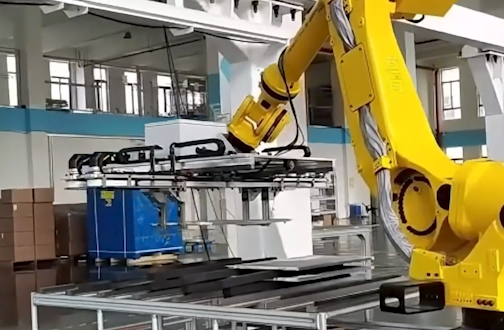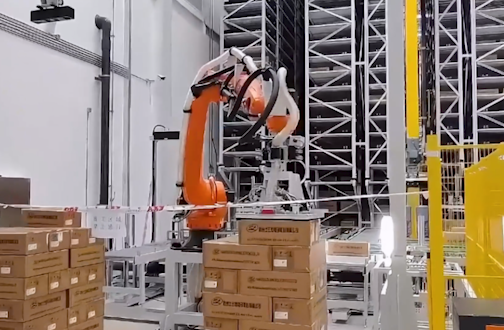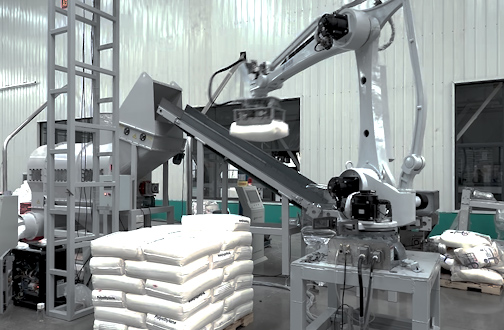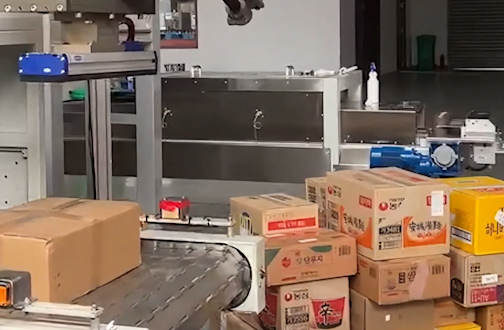






A superhard materials manufacturer implemented Transfer Technology’s 3D vision system to automate the loading and unloading of flanges, a high-frequency process in its production line.
With the new system in place, the production line completes a full loading and unloading cycle for a single flange within 45 seconds, achieving an overall 1.8× improvement in efficiency, while eliminating the need for manual intervention.
Project Background
Flanges are widely used as connecting components for pipelines, pumps, and valves. Their manufacturing processes—such as casting, forging, cutting, and rolling—require frequent loading and unloading operations across multiple stages.
Traditionally, these operations relied on manual handling, which increased labor costs and constrained production efficiency. In addition, the diversity of workpieces and the complexity of on-site assembly requirements posed further challenges to conventional approaches.
To address these issues, the customer introduced a 3D vision-guided robotic system from Transfer Technology. The system enables accurate detection and positioning of stacked, highly reflective flange workpieces, guiding the robot to perform picking, loading, and palletizing, thereby realizing full automation of the process.
Challenges
There are 2 different flange plates with weighing of 4 kg, which posed following challenges:
The objects are highly reflective and densely stacked
The maximum size of the stack is 800*800*600mm, requiring large FOV with high precision
The workstation is located near windows with varying ambient light
Requirements for vision cycle time to match the production speed for capacity improvement
Solution
Following a detailed on-site assessment, Transfer Technology, in collaboration with an integration partner, deployed a solution consisting of:
Epic Eye Laser L 3D camera + Vision software + Robot + Customized gripper
Workflow:
1. Scanning
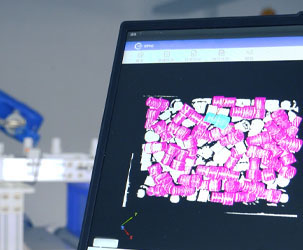
Stacks of flanges are transported into the field of view of the laser 3D camera, which captures high-quality point cloud data with sufficient detail.
2. Recognition and Planning
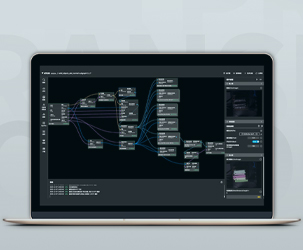
The vision software processes the point cloud data to determine the precise pose of each workpiece and intelligently generates optimized picking points and motion paths.
3. Execution
Upon receiving execution signals from the central control system, the robot follows the planned trajectory and uses a dedicated gripper to complete picking, loading, unloading, and palletizing operations.
Key highlights
01 | Advanced Algorithms for Reflective Surfaces Reflective objects are a major challenge in 3D vision. Issues such as data distortion, overexposure, and loss of surface details demand robust algorithms. Transfer Technology integrates multiple advanced algorithms to ensure reliable detection of highly reflective parts.
02 | High Flexibility for Multiple SKUs The system demonstrates excellent compatibility, easily handling different flange specifications. New product types can also be quickly integrated in the future.
03 | Reduced Labor, 1.8× Higher EfficiencyAutomation of the loading and unloading process has resulted in a 1.8× increase in production efficiency, while significantly reducing manual labor requirements.
04 | Intelligent Collision Avoidance Advanced motion planning and obstacle avoidance ensure safe and stable robot operation in complex environments, boosting speed while reducing failure rates and maintenance costs.
_ueditor_page_break_tag_
About Transfer Technology
As a leading provider of 3D industrial cameras and robot guidance systems, Transfer Technology’s solutions are widely deployed in reflective object handling scenarios, including brake discs, compressors, aluminum bars, ingots, and bolts.
Trusted by top customers across industries such as automotive, metal machining, new energy, and home appliances, our AI-powered 3D vision continues to drive smarter, more efficient manufacturing.
 Return to List