



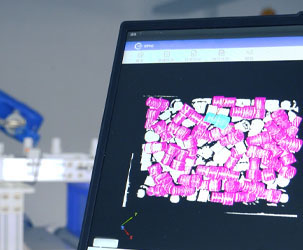
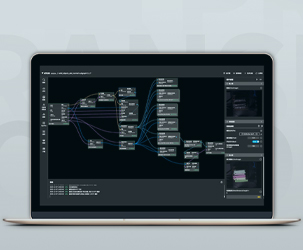


When 23 types of cartons, two pallet types, and mixed stacking patterns with flipped orientations are presented together, can a vision system still deliver stable recognition and precise positioning?
In a recently delivered intelligent depalletizing project, we proved that it can.
In real industrial environments, depalletizing is never a simple “pick-and-place” task. Cartons vary in appearance, share similar dimensions but differ in orientation, pallets arrive in both 0° and 180° directions, and odd-even interleaved stacking patterns are common. Any uncontrolled variable can cause the automation line to stall.
Recently, Transfer Technology, in collaboration with a partner company, successfully delivered a 3D vision-guided depalletizing system. The system passed on-site acceptance with a ≤5s vision cycle time and a ≥99.9% recognition rate, stably guiding robots to pick and place both cartons and totes under dual-station alternating operation.
Project Challenges
This project involves two types of materials:
Cartons
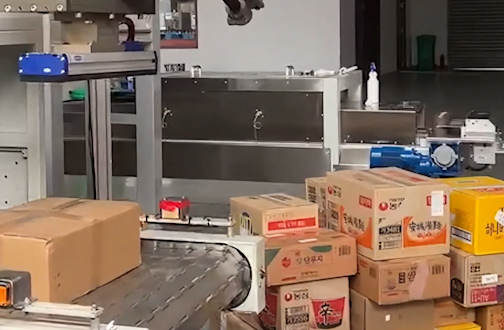
23 variants, with minimum length/width differences as small as 15 mm
Stacking patterns include regular grid layouts and odd-even interleaved layers (single/double-layer mixed stacking)
Mixed incoming orientations at 0° and 180°
Totes
Standard totes arranged in pinwheel (interlocked) stacking patterns with mixed orientations (forward/reverse)
The 3D camera is mounted on a moving mechanism, covering two depalletizing stations. It alternates between stations to capture images and guide the robot for picking and conveyor placement.
Core challenges:
Multiple SKUs, non-fixed stacking patterns, orientation recognition, and picking
sequence constraints. The vision system must not only “see,” but also “compute with precision.”
Vision Solution
The project adopts Transfer Technology’s self-developed Epic Eye Log L 3D industrial camera, specifically designed for large field-of-view logistics applications.
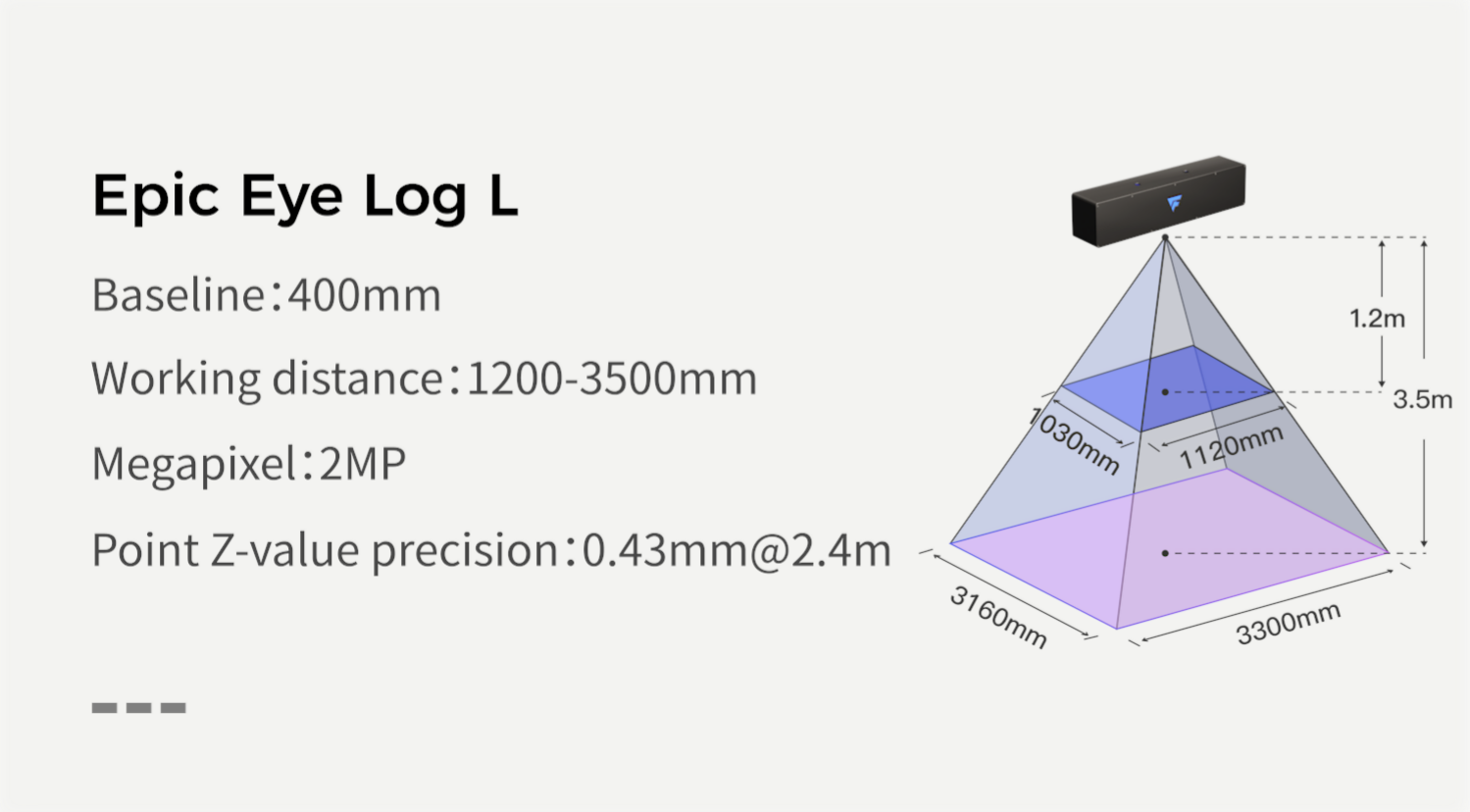
The camera is mounted directly above the center of each pallet stack, ensuring full coverage. Driven by the control system, it alternates between the two depalletizing stations for image acquisition.
The vision system communicates with the robot via TCP. Each capture calculates the pose of a single target object, operating in an interleaved rhythm with robot motion to maintain overall system efficiency.
Technical Performance
During on-site acceptance, the system achieved stable, high-performance results:
Cartons: ±5 mm recognition accuracy
Totes: ±3 mm recognition accuracy
Recognition rate: ≥99.9% (for both material types)
Vision cycle time: ≤5s per capture
The system fully meets the requirements of high-speed, continuous production. Even during commissioning, the system demonstrated strong robustness:
Stable differentiation of cartons with only 15 mm dimensional differences under grid stacking with uniform orientation
Accurate orientation output for mixed 0°/180° inputs, enabling the robot to pick in a consistent direction
Solution Highlights
In automated depalletizing, there is a significant gap between “running” and “running reliably at scale.” This project demonstrates strong practical value:
High flexibility, multi-SKU compatibility
One system supports 23 carton types and 1 tote type, handling grid, pinwheel, and interleaved
stacking patterns without extensive reprogramming.
Accurate positioning, stable picking
With adaptive pose correction, the system handles misalignment, varying orientations, and
minor surface imperfections. Combined with gripper fault-proof logic, it significantly reduces
jams, drops, and collisions.
Dual-station reuse for cost and efficiency optimization
A single 3D vision system covers two depalletizing stations, reducing hardware investment
and improving space utilization—ideal for compact factory layouts.
Standardized delivery
Clear hardware configuration, defined installation standards, and quantifiable acceptance
criteria ensure high replicability.
Transfer Technology continues to focus on deploying 3D vision technologies in real industrial scenarios. If you are planning projects in depalletizing, bin picking, positioning and assembly, feel free to contact us to discuss your application needs.
 Return to List