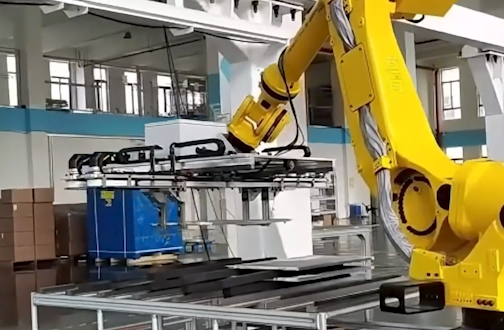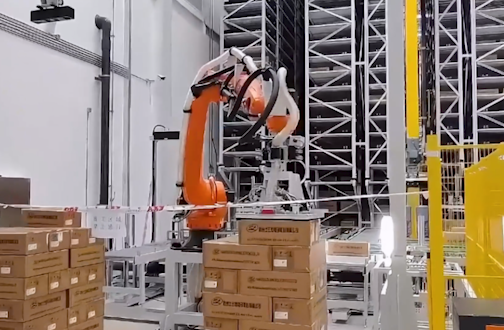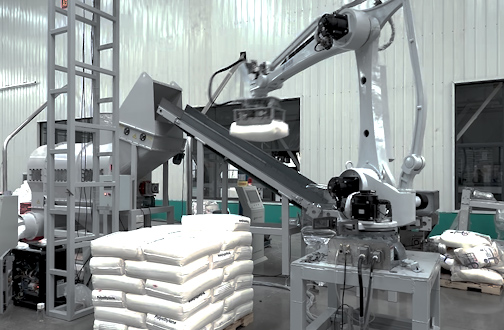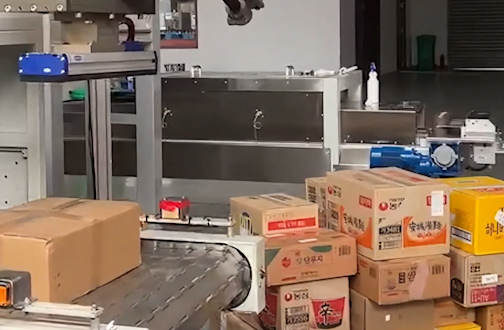






Currently, the industrial automation is booming, and 3D vision guidance technology has become a key player in the automotive manufacturing industry, steadily demonstrating its transformative power.
Painpoints
Production bottleneck:
High labor intensity due to frequent manual material handling, and the efficiency is unable to meet production demands.
Unordered arrangement:
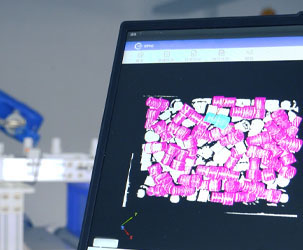
The pins are randomly arranged in deep containers, making precise picking impossible.
Reflective surfaces:
The pin hole workpieces’ reflective surfaces make it difficult to generate stable point cloud data, raising the difficulty of recognition.
Workflow
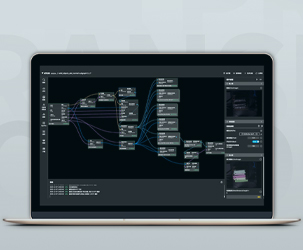
In this project, the AI+3D vision guidance system locates the automotive suspension pin holes and directs the robot to pick the pins from the bin and place them at the designated location. The specific workflow is as follows:
The workpieces are transported to the assembly station by the conveyor belt. The Epic Eye Laser L 3D camera from Transfer Technology is mounted on the end of the robot arm’s six axes and used to recognize and take photos of the workpieces and placement fixture.
Station 1 (Front Suspension): The vision system locates the pin holes of the workpiece. The fixture inserts the pins into the holes, and the robot moves the workpiece to the designated location. After the 3D camera precisely locates the placement fixture, the robot places the workpiece accurately onto it.
Station 2 (Rear Suspension): The vision system identifies the features of the workpiece, and the fixture lifts the brake disc portion. The robot moves the workpiece to the top of the placement fixture, where the camera once again ensures precise positioning, guiding the robot arm to place the workpiece on the placement fixture.
Customer Value
The application of Transfer Technology’s AI+3D vision guidance technology has provided significant benefits for the client. It has not only boosted production efficiency and product quality but also improved product consistency and stability.
At the same time, this technology has reduced manual labor intensity, lowered labor costs, and minimized reliance on human workers. The innovation has enhanced the client’s brand image and market competitiveness, enabling it to swiftly adapt to vehicle model changes without complex hardware modifications, achieving flexible production.
In terms of precision and speed, the vision system has excelled. The front suspension's precision is controlled within ±0.5mm, and the rear suspension’s precision is maintained within ±1mm, ensuring assembly accuracy. The entire system operates with a cycle time of under 12 seconds, guaranteeing high production efficiency.
As the automotive manufacturing industry continues to embrace the evolution of AI+3D vision technology, a profound transformation is underway. Traditional operational models are being gradually replaced, and a new development roadmap is taking shape, marking the dawn of a smarter and more efficient manufacturing era.
 Return to List