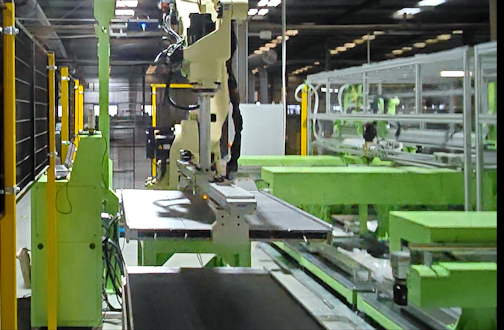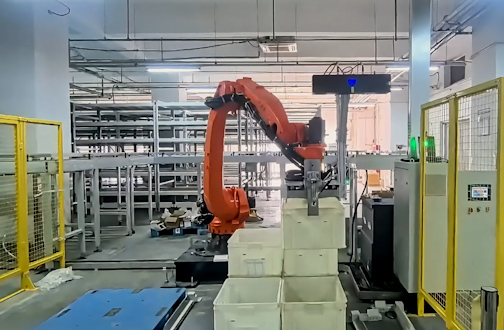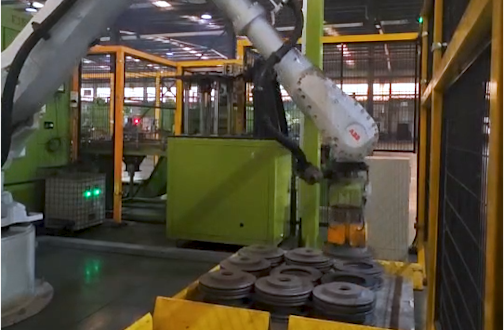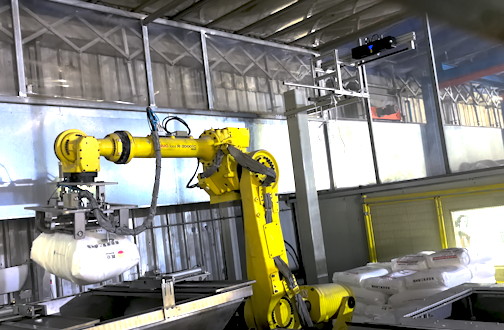






In traditional industrial settings, handling and stacking refractory bricks has long relied on manual labor. High labor intensity, inconsistent efficiency, and variable stacking accuracy have become key bottlenecks limiting both production capacity and product quality.
To tackle this challenge, a leading refractory materials manufacturer turned to automation. However, irregular brick surfaces, multiple brick types mixed on the same line, and complex lighting and reflective conditions posed stringent requirements for the stability and precision of the vision system.
Project Challenges
Before implementing automation, the company faced three core challenges in its refractory brick stacking process:
Diverse brick types with random orientations
Long bricks, slanted trapezoidal bricks, and flat trapezoidal bricks coexist in material trays in varied orientations, making it difficult for traditional 2D vision to reliably identify their 3D poses.
Severe reflection interference
Steel surfaces of feeding pallets cause strong reflections, easily leading to overexposed images and loss of critical features, resulting in missed detections.
Strict requirements for cycle time and accuracy
The production line demands high-speed continuous operation. The vision system must complete precise positioning within seconds and maintain long-term stability, as any fluctuations directly impact output.
Solution
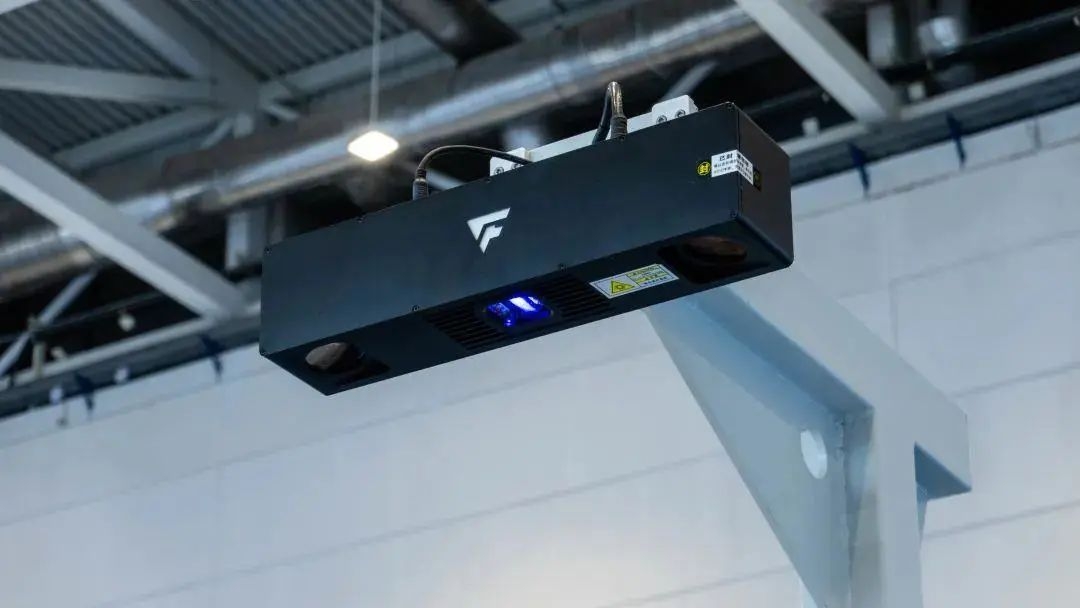
To address these challenges, we provided a vision-guided solution centered around our Epic Eye Laser L 3D industrial camera.
At the heart of this solution is the deep integration of high-precision structured-light 3D imaging with our proprietary AI recognition algorithms:
High-precision 3D reconstruction to overcome reflection interference
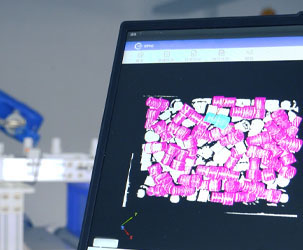
The Epic Eye Laser L uses advanced structured-light 3D imaging to quickly capture complete point clouds of refractory bricks. Through optical and algorithmic optimization, it effectively suppresses reflections from metal pallets, ensuring reliable and complete data even under complex industrial lighting.
AI-powered recognition for high reliability
Using deep learning-based template matching, the system has been trained on an extensive feature library of different brick types. It can adaptively segment and identify precise contours and surface orientations of each brick, effectively solving the issues of missed or incorrect detections that traditional algorithms struggle with in complex scenarios.Seamless hardware-software coordination for optimized cycle time
We adopted a “Eye-in-Hand” installation approach, capturing images during the robot’s movement. This parallel processing allows the vision system to complete image acquisition and pose calculation in under 4 seconds, without affecting the overall production cycle.
Customer Value
By deploying Transfer Technology’s 3D vision system, the project achieved significant gains in efficiency and quality:
Precision and reliability:
The system achieves ±2 mm accuracy in recognizing and picking all three types of bricks, fully meeting high-precision palletizing requirements.
Stable and efficient:
AI algorithms overcome on-site reflection interference, maintaining a consistent recognition rate of 99.9%. Rapid vision processing ensures smooth production line operation.
Flexible adaptation:
A single system can seamlessly handle multiple brick types, providing strong support for future product line expansion.
“Stable, precise, and easy to integrate” — this was the client’s most direct feedback. Beyond freeing human labor, the project establishes data consistency and traceability, laying a solid foundation for digital management and quality control.
The success of this refractory brick depalletizing project is not an isolated case. It clearly demonstrates a trend: in many traditional manufacturing industries undergoing transformation, high-precision 3D vision systems are evolving from a “nice-to-have” to a “must-have.”
Transfer Technology remains committed to solving real-world industrial challenges through solid technology. We will continue to advance the integration of 3D vision sensing and industrial processes, making our cameras and algorithms the most stable, trustworthy “eyes and brains” in more industrial settings, helping customers confidently step into smart manufacturing.
 Return to List