





New energy automation production lines are continuously evolving toward higher flexibility, greater precision, and faster cycle times. The loading and unloading of workpieces such as battery cells and cell trays impose stringent requirements on positioning accuracy, recognition stability, and equipment compatibility.
Traditional robot grasping methods that rely on manual teaching and fixed fixtures struggle to handle challenges such as AGV incoming material deviations, tight workpiece spacing, and mixed-model production. In these scenarios, 3D industrial vision has become the core technical solution for high-precision depalletizing and palletizing.
This project was deployed at the site of a domestic new energy equipment integrator. A 3D vision system guides the robot to perform fully automated picking and palletizing of battery cells and cell trays.
Project Challenges
Ultra-Narrow Gaps with Near-Zero Margin for Error
The gap between battery cells and protective plate grooves is only 1mm. Even slight visual positioning deviation can lead to jamming, placement failure, or workpiece damage.
Multi-Layer Stacking Requires Consistent Reference
Protective plates may shift during operation. The vision system must accurately locate the center of the protective plate on the first layer and use it as the consistent reference for all subsequent layers. Any initial deviation will accumulate with each layer, causing the entire stack to tilt progressively.
Tight Cycle Time Requirements
The production line runs in continuous flow. The vision system’s cycle time must keep up with the robot’s rhythm, otherwise it will become the bottleneck of the entire line.
Complex On-Site Conditions
Variable on-site lighting, along with deformation of pallets and protective plates, can easily affect imaging quality and recognition stability.
Solution
We adopt an "Eye-in-Hand" mounting solution. The Epic Eye Pixel Pro 3D smart camera is mounted directly on the robot’s end-effector, pointing vertically downward. It captures both the workpiece and tray poses in real time, enabling full closed-loop visual guidance throughout the entire process.
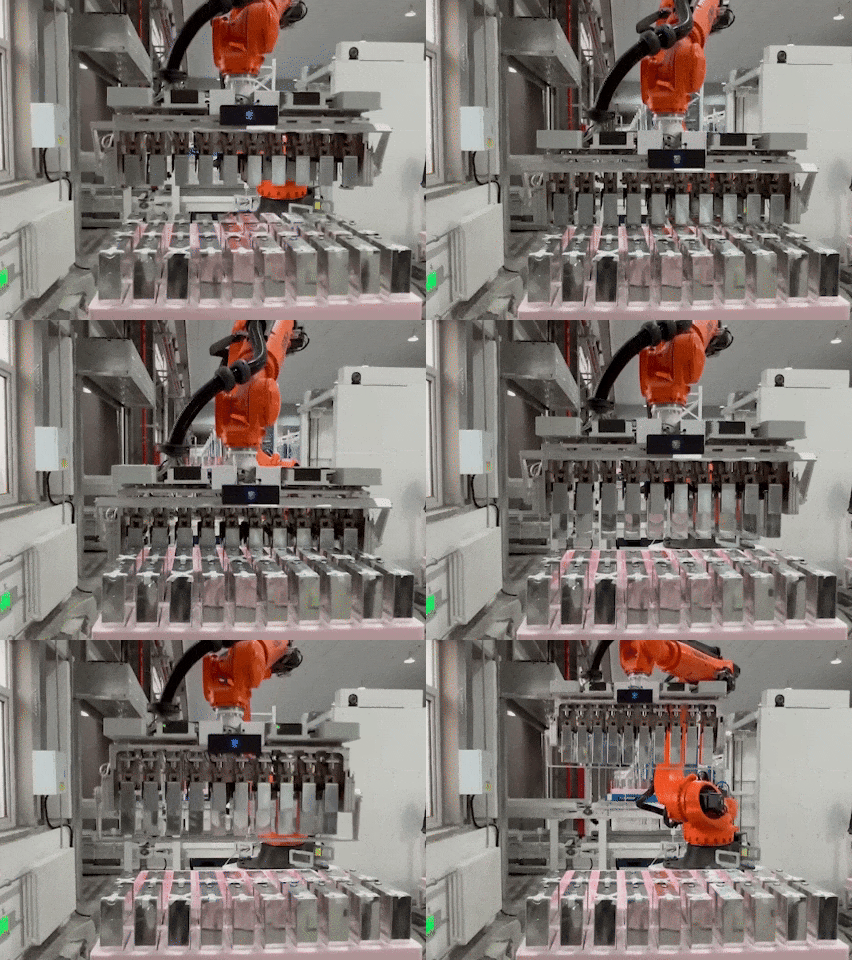
Workflow:
Step 1: Protective Plate Positioning
The robot moves the camera above the palletizing station and captures two diagonal images
of the bottom protective plate. The system checks whether the plate has a 90° rotation offset.
If a deviation is detected, an alarm is triggered. If normal, the system calculates the center pose
of the protective plate and generates the placement coordinates for all battery cells.
Step 2: Battery Cell Recognition
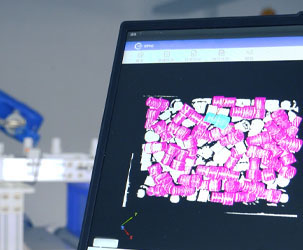
The robot moves to the depalletizing station. The camera captures images of a portion of the cells and calculates the pose information and gripping coordinates for a full row of 10 cylindrical cells.
Step 3: Layer-by-Layer Picking and Palletizing
The robot picks up one complete row at a time and places it into the corresponding grooves of the protective plate. After completing each layer, an intermediate cover is placed before proceeding to the next layer, until the entire stack is finished.
Deployment Value
This project has successfully delivered stable visual guidance for the loading and unloading of battery cells and cell trays. In actual production, it brings tangible benefits in three key areas:
Significantly Improved Precision and Stability
Achieved repeatable positioning accuracy of ±0.5mm for battery cells and ±1mm for
cell trays, with a picking success rate of ≥99.9%. This effectively eliminates issues such
as empty picks, misalignment, and material jamming.
Production Efficiency Meets High-Speed Line Demands
Single image recognition takes ≤3 seconds, and one-time positioning of the pallet/protective
plate can be reused throughout the entire process, fully satisfying the high-speed cycle time
demands of automated production lines.
Enhanced Production Line Flexibility
A single system supports both battery cells and cell trays, enabling quick switching between
multiple stack types and pallet configurations. This significantly improves line reusability
and scalability.
 Return to List