





As manufacturing continues advancing toward higher levels of automation and intelligence, the handling of precision components such as crankshafts remains a challenging application for robotic systems.
Variations in part positioning, reflective metal surfaces, and demanding cycle-time requirements often limit the reliability of conventional automation approaches. For crankshaft handling applications in particular, stable and accurate part localization is critical to ensuring consistent machine loading performance.
To address these challenges, Transfer Technology partnered with a leading intelligent equipment provider to deploy a 3D vision-guided robotic loading and unloading system for crankshaft handling.
01
Application Challenges
Crankshafts are highly reflective metal components with complex geometries, making them a demanding target for machine vision systems.
In this application, multiple crankshaft models are stored in an organized rack structure. The vision system is required to identify each part, determine its position and orientation, guide robotic picking at the cylindrical input-end section, and accurately place the crankshaft into a machine tool V-block.
The project presented several key challenges:
Variations in incoming part positions within the rack;
Reflective metallic surfaces that can affect image quality and detection stability;
High requirements for accuracy and production cycle;
Compatibility with multiple crankshaft models within a single production workflow.
02
Solution
The project utilizes Transfer Technology's Epic Eye Laser L V2S 3D smart camera, mounted on a fixed support structure overlooking the entire rack area.
By combining blue-laser 3D imaging technology with AI-powered recognition algorithms, the system enables reliable crankshaft identification and robotic guidance throughout the loading process.
Workflow
Step 1: Material Loading
Operators place a rack loaded with crankshafts at the designated loading station. Once the station is ready, the PLC triggers the vision process.
Step 2: 3D Recognition and Pose Calculation
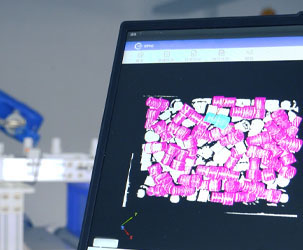
The vision system performs blue-laser scanning to generate high-quality 3D point cloud data. AI algorithms automatically distinguish between three crankshaft models and calculate the optimal grasping positions and pose information required for robotic handling.
Step 3: Robotic Picking and Machine Loading
The calculated pose data is transmitted to the robot, which picks the crankshaft at the designated cylindrical section and places it into the machine tool V-block for machining.
Step 4: Rack Changeover
Once all crankshafts on one side of the rack have been processed, the system outputs an empty-rack notification. Operators then switch to the opposite side of the rack to continue production. After the entire rack is emptied, a new rack is loaded and the cycle repeats.
The blue-laser imaging technology provides strong resistance to ambient light interference and maintains stable point cloud acquisition even under challenging workshop conditions, including stray lighting and light surface contamination from oil residue.
03
Technical Highlights
High-Precision Robotic Guidance
The system achieves vision repeatability of ±0.5mm and recognition accuracy of ±2mm. Accurate pose calculation enables reliable robotic gripping and precise placement into the machine tool V-block, helping minimize positioning errors, handling damage, and machine-loading interruptions.
Enhanced Production Efficiency
Image acquisition and processing are completed within 4 seconds per cycle, supporting continuous production flow while meeting cycle-time requirements.
Greater Manufacturing Flexibility
The ability to handle multiple crankshaft variants within a single deployment simplifies production changeovers and supports future product expansion without significant hardware changes.
As manufacturers continue pursuing higher levels of automation, AI-powered 3D vision is playing an increasingly important role in precision component handling applications. By combining accurate 3D perception with intelligent robotic guidance, manufacturers can achieve greater efficiency, consistency, and flexibility across machining and material handling operations.
 Return to List