Designed for Collaborative Robots! Transfer Technology’s Industrial 3D Camera Pixel Mini Delivers Unexpected Compact Performance
Transfer Technology today unveiled its self-developed Epic Eye Pixel Mini ultra-compact industrial 3D camera. Equipped with blue fringe structured light, the camera sets a new benchmark among same-baseline products in compact size, lightweight design, high precision, rapid imaging and cost efficiency.
The product series is fully designed to meet modern industrial requirements for flexible and high-precision operations. It delivers outstanding point cloud accuracy for eye-in-hand applications on collaborative and hybrid robots, greatly boosting operational accuracy and task success rate.
Golden Combination Usher in a New Manufacturing Era
Featured with high flexibility and intelligence, collaborative and hybrid robots have gained widespread adoption in the Industry 4.0 era. According to GGII (High-Tech Robot Industry Research Institute), China’s annual sales of collaborative robots will exceed 100,000 units by 2026, driving growing market demand for miniaturized, high-precision industrial 3D cameras.
The golden combination of 3D vision guidance and collaborative/hybrid robots empowers robots with advanced perception and decision-making capabilities. It effectively improves production line flexibility, automation level and human-machine safety, emerging as a core trend fueling the advancement of the robotics industry.
Pixel Mini Product Advantages at a Glance
1. Ultra-High Accuracy and Superior Imaging Performance
Tested to the VDI/VDE 2634 guideline, the Pixel Mini achieves a measurement accuracy of 0.1 mm at 0.5 m, delivering leading imaging precision among peer products with the same baseline. It generates accurate, complete and high-clarity point cloud data for diverse workpieces, suppporting challenging working conditions including disordered stacking, fine surface textures and slightly reflective surfaces.
The superior precision effectively improves overall production efficiency and reduces rework and line downtime caused by positioning deviations.
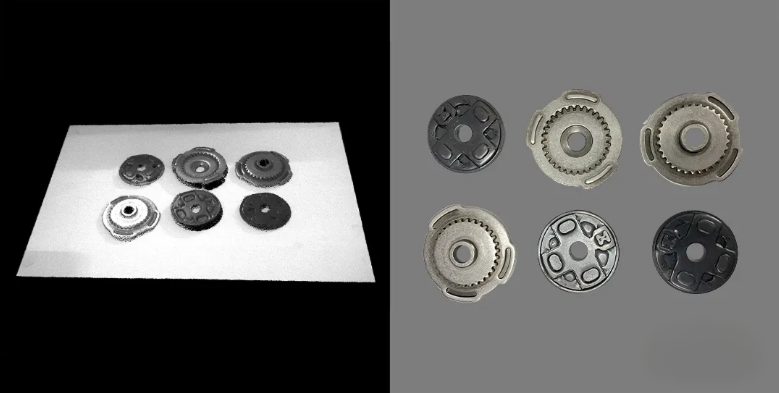
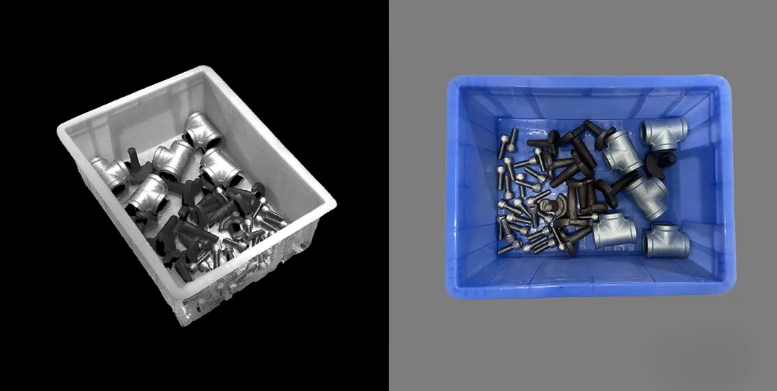
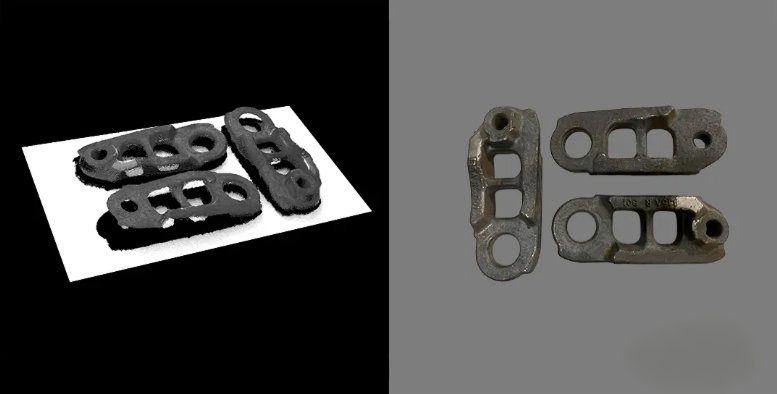
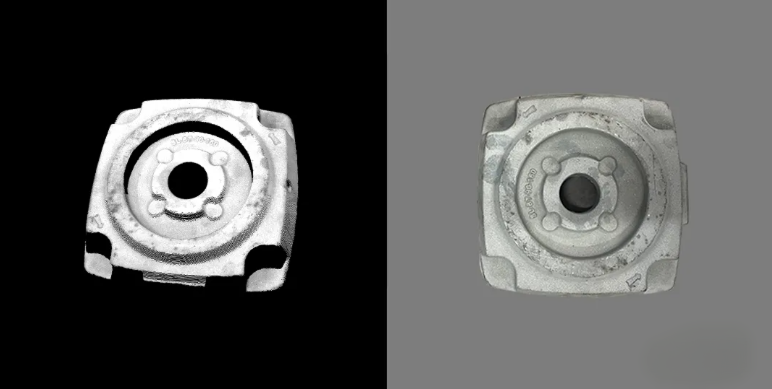
2. Ultra-Fast 0.2s Acquisition Speed for Instant Capture
The Pixel Mini supports image capture in as little as 0.2 seconds, outperforming comparable products on the market. Its rapid acquisition speed enables real-time capture of shifting production environments and target workpieces. The system receives immediate data to adjust motion programs, guaranteeing responsive and precise operation. This capability shortens line cycle time and boosts overall production throughput.
3. Cellphone-Sized Compact Design for Precision Scenarios
In eye-in-hand applications, end-effector load is a critical consideration for robotic arm configuration. Excessive end weight may compromise the robot’s moving speed and operational accuracy.
Accordingly, precise load control is essential to sustain stable robot performance. For industrial 3D cameras, lightweight construction poses significant technical challenges. Robust mechanical frames are required to prevent structural accuracy degradation, paired with refined thermal dissipation designs to curb thermal drift.
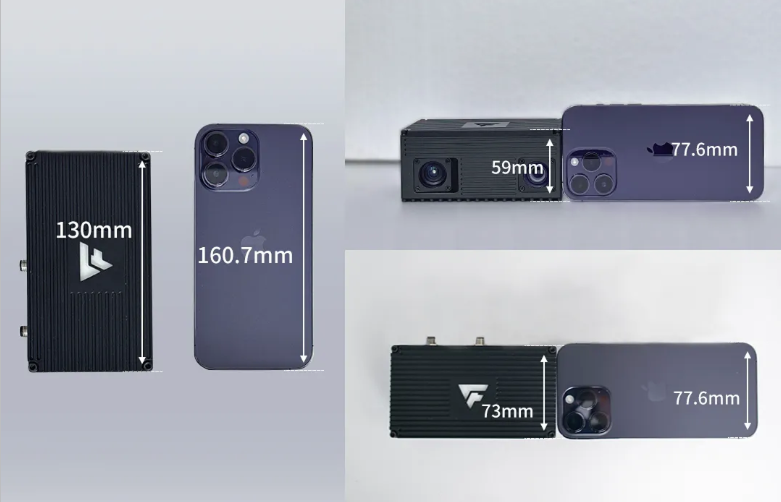
Leveraging optimized mechanical structures and hardware layouts, the Pixel Mini delivers a highly compact form factor when measured against other cameras with identical stereo baselines. It weighs just 0.8 kg and measures 130 × 59 × 73 mm, featuring a slim footprint that facilitates installation in confined machine spaces.
The ultra-light and ultra-compact design fully reserves robot end load margin and improves vision system installation flexibility. It enables reliable deployment in precision tasks, complex working conditions and confined space spaces.
4. 4.5W Ultra-Low Average Power Consumption Ensures Continuous Operation
In automated production lines and complex industrial scenarios, high power consumption of 3D vision cameras can shorten the battery life of hybrid robots, leading to frequent recharging and disrupting operational continuity and overall line efficiency.
The Epic Eye Pixel Mini features an average power consumption of only 4.5 W¹ and a standby power consumption of 2.4 W. The low-power design improves energy utilization for hybrid robots, optimizes overall energy efficiency, and reduces long-term operational costs. Its high-efficiency, low-power performance also demonstrates Transfer Technology’s commitment to sustainable development in industrial automation.
Note ¹: The maximum instantaneous power is 32 W. Average power consumption is tested under standard room temperature conditions, with an acquisition time of 700 ms and an exposure interval of 7.3 s.
Pixel Mini Camera Detailed Technical Specifications
| Parameter | Pixel Mini |
|---|---|
| Baseline Length | 85mm |
| Recommended Operating Distance | 300~700mm |
| Near Field of View | 290mm×180mm@0.3m |
| Far Field of View | 650mm×420mm@0.7m |
| VDI/VDE Measurement Accuracy | 0.1mm@0.5m |
| Typical Acquisition Time | 0.2s~0.7s |
| Power Supply | 24V ⎓ 3.75A |
| Dimensions (L*W*H) | 130mm×59mm×73mm |
| Weight | 0.8kg |
Moving forward, Transfer Technology stays dedicated to developing products that satisfy and surpass customer expectations. The company will continue to iterate product functions and core technologies, delivering reliable intelligent vision solutions to help manufacturing customers reduce operational costs and improve overall production benefits.
Start Your
3D Vision Journey
Whether it's product selection, custom solutions, or technical support — our expert team is always ready to help.
Service Hotline
4000-191-161
Business Email
marketing@qianyi.ai
19110438869
Office Locations
Beijing HQ
Floor 14, Building 2, Weilai Park South Zone, Changping District, Beijing