New energy automated production lines are evolving toward high flexibility, high precision and ultra-fast cycle times. The loading and unloading of core components such as battery cells and cylindrical workpieces raise stringent standards for positioning accuracy, recognition stability and equipment compatibility. Traditional robotic grasping solutions that rely on manual teaching and fixed tooling are incapable of adapting to complex production scenarios, including AGV feeding deviation, ultra-narrow workpiece gaps and mixed-model mass production. As a result, 3D machine vision has become the core technology to realize high-precision depalletizing and stacking for new energy production. This project is deployed at the site of a domestic new energy equipment integrator, adopting a professional 3D vision system to guide industrial robots in completing automatic grasping, loading and precise stacking of battery cells and cylindrical workpieces.
Project Challenges
1.Near-zero error tolerance with ultra-narrow gaps
The gap between each battery cell and the protective plate groove is merely 1 mm. Tiny positioning deviation will directly cause workpiece jamming, scratching or structural damage during placement, requiring extremely high visual positioning accuracy.
Consistent benchmarking required for multi-layer stacking Protective plates are prone to slight displacement on site. The vision system must accurately calibrate the center benchmark of the protective plate during the first-layer stacking and maintain unified reference coordinates for all subsequent layers. Any benchmark deviation will lead to cumulative misalignment and overall irregular stacking.
2.Strict cycle time constraints
The assembly line operates continuously at high speed. The vision recognition and positioning cycle must fully match robotic operation rhythm, otherwise it will become the core bottleneck restricting overall production capacity.
3.Complex and variable on-site working conditions
Unstable ambient light, tray deformation and protective plate distortion interfere with imaging effects, bringing great challenges to long-term stable recognition.
Customized Solution
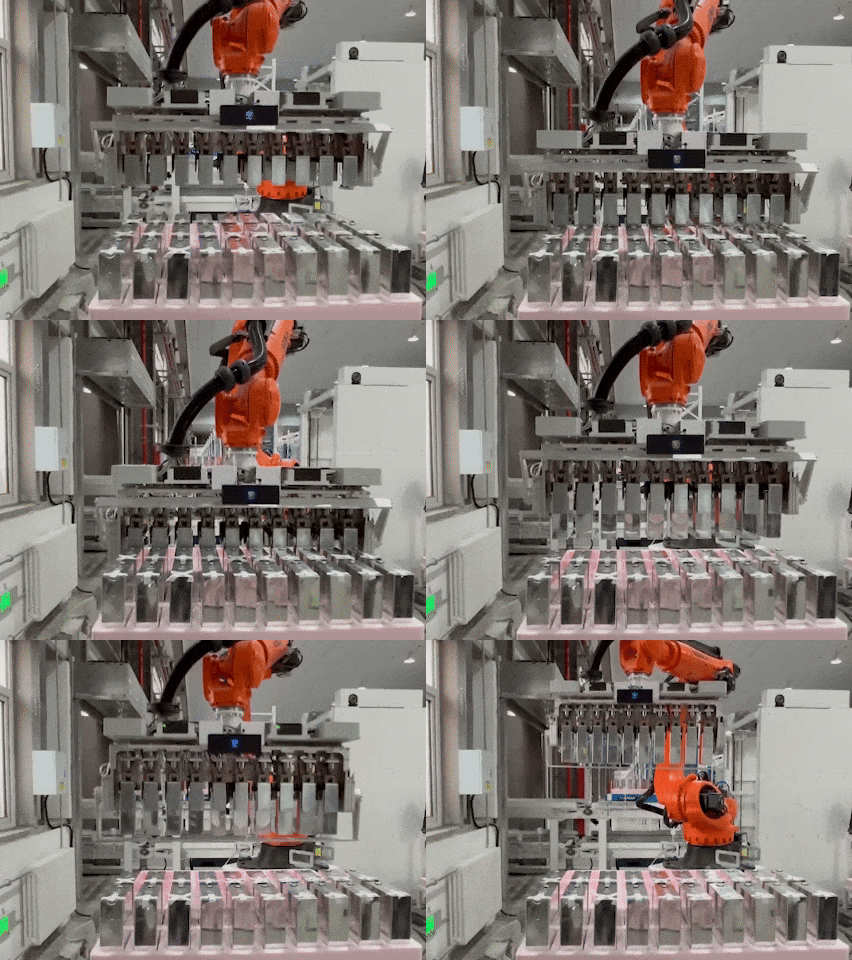
The project adopts a matureeye-in-hand solution. The self-developed Epic Eye Pixel Pro 3D smart camera is mounted on the robot end-effector, capturing images vertically downward to achieve full-coverage detection of workpiece and tray poses. It realizes full-process closed-loop visual guidance for automatic grasping and stacking.
Standard Automated Workflow:
1.Protective Plate Benchmark Positioning
The robot carries the 3D camera to the stacking station and performs diagonal dual scanning of the bottom protective plate. The system intelligently identifies whether the plate has a 90° rotation deviation and triggers an alarm for abnormal placement. For normal placement, it calculates the precise center pose of the protective plate and generates accurate placement coordinates for all battery cells.
2.Battery Cell 3D Recognition & Calculation
The robot moves to the depalletizing station for targeted scanning. The camera quickly captures complete 3D point cloud data of batch battery cells, and the algorithm independently solves the pose information and grasping coordinates of an entire row of 10 cells.
3.Layer-by-Layer Intelligent Stacking
The robot grasps one full row of battery cells at a time and accurately places them into the corresponding grooves of the protective plate. After completing single-layer stacking, the robot automatically places the intermediate cover and proceeds with the next-layer operation. The cycle repeats until the entire stacking task is completed.
Project Value & Benefits
The solution realizes stable and high-precision visual-guided loading and stacking for new energy battery cells and cylindrical workpieces, effectively solving multiple industry pain points and bringing substantial production upgrades:
1.Higher Precision & Operational Stability
It achieves a repeated positioning accuracy of ±0.5 mm for battery cells and ±1 mm for cylindrical workpieces, with a grasping success rate of over 99.9%. It completely eliminates production faults such as empty grasping, placement misalignment and workpiece jamming, ensuring consistent processing quality.
2.Qualified High-Speed Production Cycle
The single-scan recognition and calculation time is ≤3 seconds. The protective plate and tray only require one-time benchmark positioning for full-process reuse, perfectly matching the high-speed operation rhythm of automated new energy production lines.
3.Improved Production Line Flexibility
A single vision system is compatible with two types of workpieces: battery cells and cylindrical parts. It supports rapid switching of multiple stacking modes and tray specifications, greatly improving production line versatility, reducing renovation costs, and reserving flexible expansion space for subsequent production upgrades.
Start Your
3D Vision Journey
Whether it's product selection, custom solutions, or technical support — our expert team is always ready to help.
Service Hotline
4000-191-161
Business Email
marketing@qianyi.ai
19110438869
Office Locations
Beijing HQ
Floor 14, Building 2, Weilai Park South Zone, Changping District, Beijing