In the wave of intelligent manufacturing transformation, automated robotic loading and unloading for precision components such as crankshafts has long been plagued by challenges including position deviation of incoming workpieces, reflective surfaces and stringent cycle time requirements. Recently, Beijing Transfer Technology Co., Ltd. partnered with an intelligent equipment manufacturer to deploy a 3D vision intelligent loading & unloading system for crankshaft gripping operations.
01Project Background
In automotive component manufacturing, crankshafts are irregular reflective metal workpieces. Their automated loading and unloading faces two persistent difficulties: positional deviation of incoming materials and surface reflection, which prevents stable imaging with conventional 2D vision.
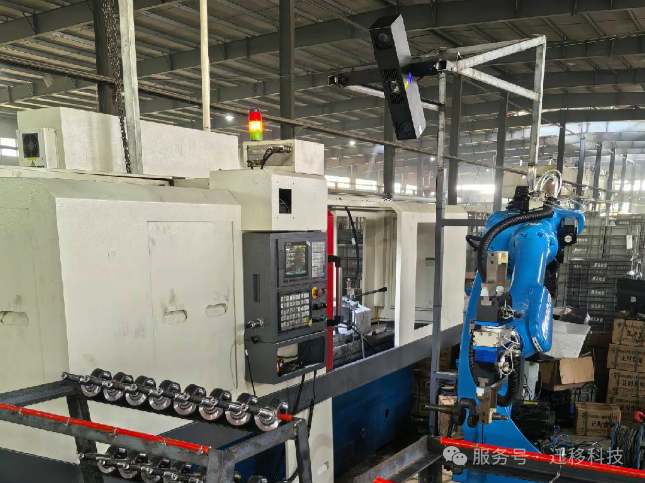
At the customer’s facility, multiple specifications of crankshafts are neatly arranged on racks. The vision system is required to identify workpiece poses, guide the robot to grip the cylindrical section at the input end, and place each crankshaft into the machine tool V-groove. The production line imposes clear specifications on recognition accuracy and operating cycle time.
02Workflow
This project adopts the Epic Eye Laser L V2S 3D smart camera. The camera is fixedly mounted on a bracket and captures images obliquely downward to cover the entire rack area, enabling a closed-loop automated workflow. Detailed operating procedures:
Manual Feeding: Operators push a standard rack loaded with crankshafts to the fixed feeding station. Once the equipment is ready, the PLC control system sends a scanning command to the 3D vision system.
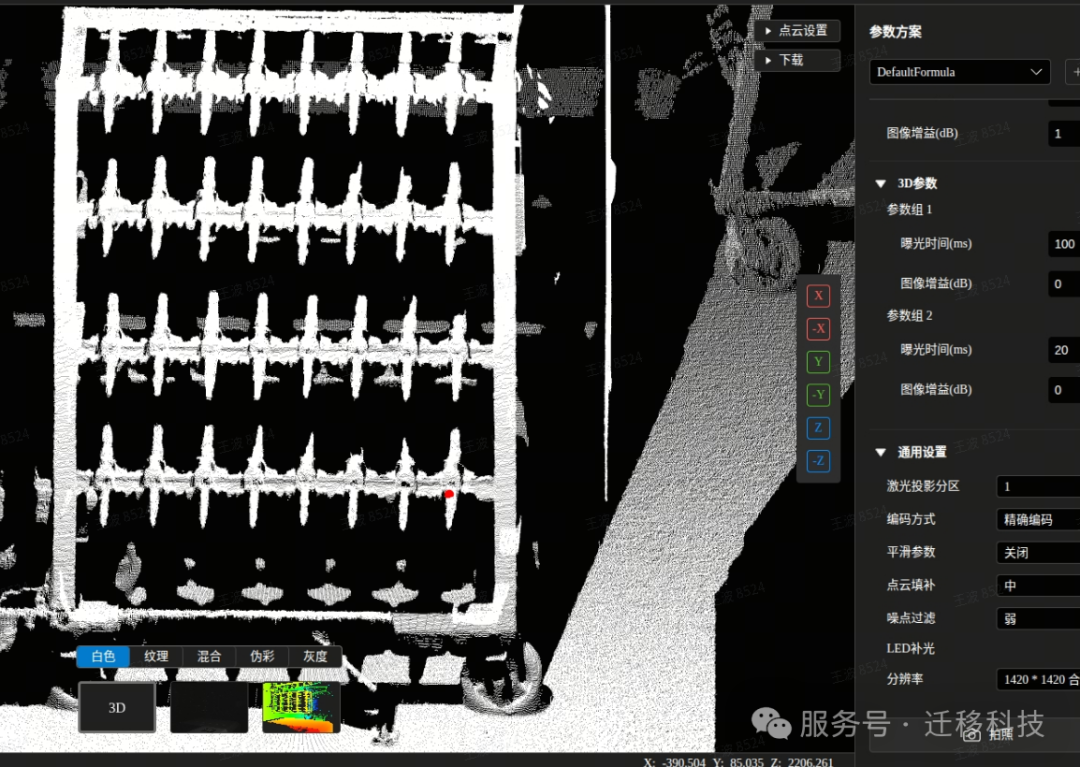
Recognition & Calculation: The camera initiates blue laser scanning to acquire 3D point cloud data of workpieces. Built-in AI algorithms automatically distinguish three crankshaft models and accurately compute optimal gripping points and pose information.
Vision-Guided Gripping: The camera transmits pose data to the robot. The robot grips the root of the crankshaft’s input end and positions it into the machine tool V-groove.
Rack Switching: After all workpieces on one side of the rack are picked, the vision system sends an empty-rack signal. Operators switch to the other side of the rack to continue production. Once the whole rack is emptied, a new rack is replaced for cyclic operation.
Equipped with blue laser imaging technology, the camera delivers strong anti-interference performance. It can capture complete and continuous point clouds of crankshafts even under workshop stray light and slight oil contamination on workpiece surfaces, supporting precise algorithm computation.
03Technical Highlights
High Precision
VISION REPEATABILITY: ±0.5 mm; RECOGNITION ACCURACY: ±2 mm. The precision perfectly matches gripper clearance, eliminating workpiece clamping damage, placement deviation and machine tool jamming, and greatly reducing crankshaft scrap rate.
High Efficiency
The total duration for single scanning and algorithm computation is ≤4 seconds. It seamlessly matches the continuous machining cycle of machine tools and enables non-stop automated feeding at the station.
High Flexibility
Compatible with multiple crankshaft models and supports rapid model expansion for newly introduced products.
Start Your
3D Vision Journey
Whether it's product selection, custom solutions, or technical support — our expert team is always ready to help.
Service Hotline
4000-191-161
Business Email
marketing@qianyi.ai
19110438869
Office Locations
Beijing HQ
Floor 14, Building 2, Weilai Park South Zone, Changping District, Beijing