When 23 types of cartons, two pallet types, and mixed 0°/180° stacking patterns are present, can the vision system still stably recognize and precisely locate them? We found the answer in a recently delivered intelligent de-stacking project.
On the industrial shop floor, de-stacking is never a simple 'handling task.' Different carton colors, similar dimensions but varying orientations, pallet arrival mixed at both 0° and 180°, and interlaced odd/even layers stacking—any variable that is not well controlled can stall the automated production line.
Recently, the 3D vision intelligent de-stacking project cooperated by Beijing Transfer Technology Co., LTD and an intelligent technology company passed acceptance. In a dual de-stacking station alternating operation scenario, the system stably guided the robot to grab and place cartons and totes with high precision at a camera cycle time ≤ 5 s per scan and a recognition rate ≥ 99.9%.
I. Project Challenges
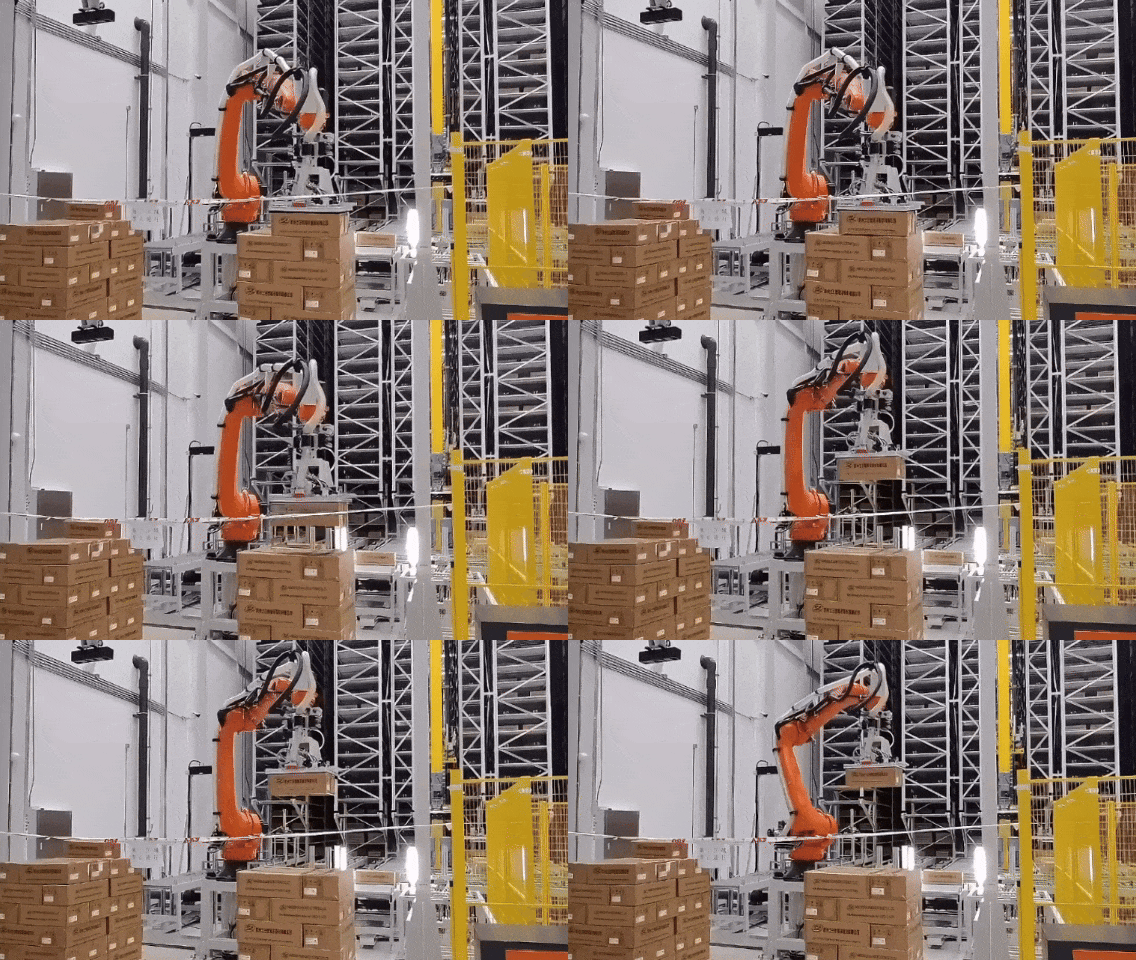
The project requires handling two types of workpieces simultaneously:
Cartons: 23 specifications, with the smallest length/width difference of only 15 mm; stacking patterns include regular grid stacks and single/double-layer stacks with odd/even mixed pressing, and incoming directions have both 0° and 180° postures.
Totes: Standard totes stacked in five-flower patterns, also with mixed 0°/180° placement.
The camera must be mounted on a moving mechanism to cover two de-stacking stations, alternating between stations C and D for 3D scanning, guiding the robot to grab and discharge onto the conveyor.
The core difficulty lies in the variety of workpieces, unfixed stacking types, the need to determine orientation, and the importance of picking order—the vision system must not only 'see' but also 'calculate accurately.'
II. Vision Solution
The project uses Transfer Tech's self-developed Epic Eye Log L 3D industrial camera, fixed on a moving mechanism, switching between the two de-stacking positions for scanning as commanded by the control system.
{{节拍2.jpg}}
The camera is mounted directly above the center of the stack to ensure full coverage of the entire pile. The vision system communicates with the robot via TCP. A single scan outputs the posture information of one workpiece, interleaving with the robot's motion rhythm without affecting overall efficiency.
III. Technical Indicators
The entire system achieved high performance during on-site acceptance: for cartons, recognition accuracy of ±5 mm; for totes, recognition accuracy of ±3 mm. The recognition rate for both types reached ≥ 99.9%, and the vision cycle time was ≤ 5 s per scan, fully meeting the continuous operation requirements of high-speed production lines.
During the debugging phase, the system demonstrated stable recognition capability—even when the length/width difference of cartons was only 15 mm, and the stack was a grid stack with consistent orientation, the vision could still distinguish stably; when incoming workpieces had mixed 0°/180° orientations, the vision clearly output the workpiece orientation, guiding the robot to grab in a fixed direction.
IV. Solution Highlights
In the field of automated de-stacking, there is a huge engineering gap between 'being able to run' and 'being able to produce stably.' The value of this project lies in:
Extreme flexibility, multi-specification compatibility: A single system accommodates 23 types of cartons + 1 type of tote, supports multiple stacking patterns such as five-flower stacks, grid stacks, and odd/even mixed stacks, and requires no major program changes for format changeover;
Precise positioning, stable grabbing: In response to incoming material offset, varying box orientations, and slight surface defects, the 3D vision adaptively corrects posture, and combined with the gripper's foolproof logic, significantly reduces jamming, dropping, and damage;
Dual-station reuse, cost reduction and efficiency improvement: A single 3D vision system covers two de-stacking stations, saving hardware investment and increasing space utilization, suitable for compact workshop layouts;
Standardized delivery: Clear hardware list, defined installation specifications, quantified acceptance standards, and replicable.
Transfer Technology always focuses on the on-site integration of 3D vision-guided technology in industrial scenarios. If you are planning projects such as intelligent de-stacking, random bin picking, or positioning assembly, welcome to contact us to discuss specific requirements.
Start Your
3D Vision Journey
Whether it's product selection, custom solutions, or technical support — our expert team is always ready to help.
Service Hotline
4000-191-161
Business Email
marketing@qianyi.ai
19110438869
Office Locations
Beijing HQ
Floor 14, Building 2, Weilai Park South Zone, Changping District, Beijing