





As new energy production lines continue advancing toward higher flexibility, tighter tolerances, and faster takt times, automation standards are being redefined.
In battery cell loading and unloading, throughput is no longer determined by robotic speed alone. Real production performance depends on whether the system can maintain stable precision under minimal spacing, incoming material deviations, mixed-model workflows, and complex industrial conditions.
When positioning tolerance shrinks to around 1 mm, even slight visual deviation can lead to insertion failure, product damage, or cumulative stacking errors.
In next-generation battery manufacturing, faster motion without reliable perception does not improve productivity—it simply increases the speed of mistakes.
For high-precision battery loading, the real upgrade is not speed alone.
It is adaptive precision.
Project Overview: 3D Vision-Guided Battery Cell and Tray Loading
In this deployment for a domestic new energy equipment integrator, Transfer Technology’s AI + 3D vision system guides robots to complete battery cell and tray loading automatically.
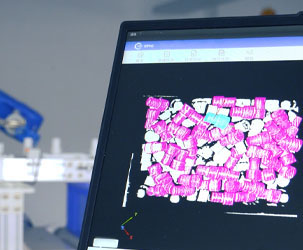
Using an eye-in-hand architecture, the Epic Eye Pixel Pro 3D smart camera is mounted directly on the robot arm, capturing real-time positional data for both battery cells and trays to enable closed-loop robotic guidance throughout the full loading process.
Rather than relying on fixed coordinates or manual teaching, the system continuously adapts to real production variability—improving both precision and operational stability.
In High-Precision Loading, Small Errors Don’t Stay Small
Traditional robotic loading systems often perform well in static environments, but battery production lines present a very different reality.
AGV material delivery deviations, tray displacement, lighting fluctuation, and mixed production requirements can all push real conditions beyond predefined assumptions.
In this project, four major challenges directly shaped system design:
Minimal clearance, near-zero margin for error
The gap between battery cells and tray grooves is only about 1 mm.
Even slight positioning deviation can cause insertion jams, placement failure, or component damage.
Multi-layer stacking consistency
Tray position may shift before loading begins.
The system must accurately identify the tray center during the first layer and maintain that reference baseline across all subsequent layers.
If the first reference is off, every following layer compounds the error.
Throughput pressure
Because this is a conveyor-based production workflow, visual recognition speed must match robotic takt time.
If perception lags, vision becomes the bottleneck.
Complex industrial variability
Lighting conditions, tray deformation, and positional inconsistencies all affect imaging stability and recognition reliability.
In battery loading, precision is not a one-time requirement.
It must be maintained continuously from first pick to final stack.
Why Eye-in-Hand 3D Vision Becomes Essential
To address these challenges, Transfer Technology deployed Epic Eye Pixel Pro in a robot-mounted eye-in-hand configuration.
Mounted vertically on the robot end-effector, the system combines flexible movement with sub-millimeter 3D perception, transforming robotic loading from fixed-position execution into adaptive, perception-driven automation.
This allows one integrated system to validate tray positioning, recognize battery cells, and guide loading dynamically throughout the full workflow.
Workflow: From Tray Validation to Layer-by-Layer Precision
Step 1: Tray positioning and validation
Before loading begins, the robot moves above the tray station and captures diagonal views of the tray structure.
The system verifies tray orientation, detects rotational deviation, and calculates the tray center pose.
This establishes the baseline reference for all subsequent loading positions.
Step 2: Battery cell recognition
The robot then moves to the depalletizing station, where the camera captures battery cells and calculates pose information for a full row of 10 cells, generating precise grasping coordinates.
Step 3: Guided layer-by-layer loading
The robot picks one full row at a time and places cells into corresponding tray grooves.
After each layer is completed, an intermediate cover is placed before continuing to the next layer until full palletizing is complete.
Rather than depending on static programming assumptions, the system continuously uses 3D data to maintain process consistency from first layer to final stack.
From Visual Recognition to Production Reliability
The value of this deployment is not simply automated picking.
It is production-grade precision, speed, and flexibility.
Higher precision, lower failure risk
±0.5 mm repeatable positioning accuracy for battery cells
±1 mm repeatable positioning accuracy for tray-related components
≥99.9% picking success rate
Prevents empty picks, misalignment, and material jams
Speed without sacrificing control
Single-shot visual recognition completed within 3 seconds
One-time tray positioning reference reused throughout the full stacking cycle
Meets high-speed automated production line requirements
Flexible deployment across changing production demands
One system supports both battery cells and tray-based components
Compatible with multiple pallet types and stacking configurations
Enables faster product switching and scalable production expansion
The Real Shift: From Faster Automation to Smarter Loading
As battery manufacturing continues scaling, speed alone is no longer enough.
Without stable perception, faster robotic movement can simply produce faster errors.
This project demonstrates a broader transformation in new energy automation:
Transfer Technology’s AI + 3D vision system helps move battery production beyond fixed robotic execution toward adaptive, precision-first automation.
Because in advanced manufacturing, the goal is not just to move faster—
It is to load accurately, consistently, and intelligently every time.
 リストに戻る